
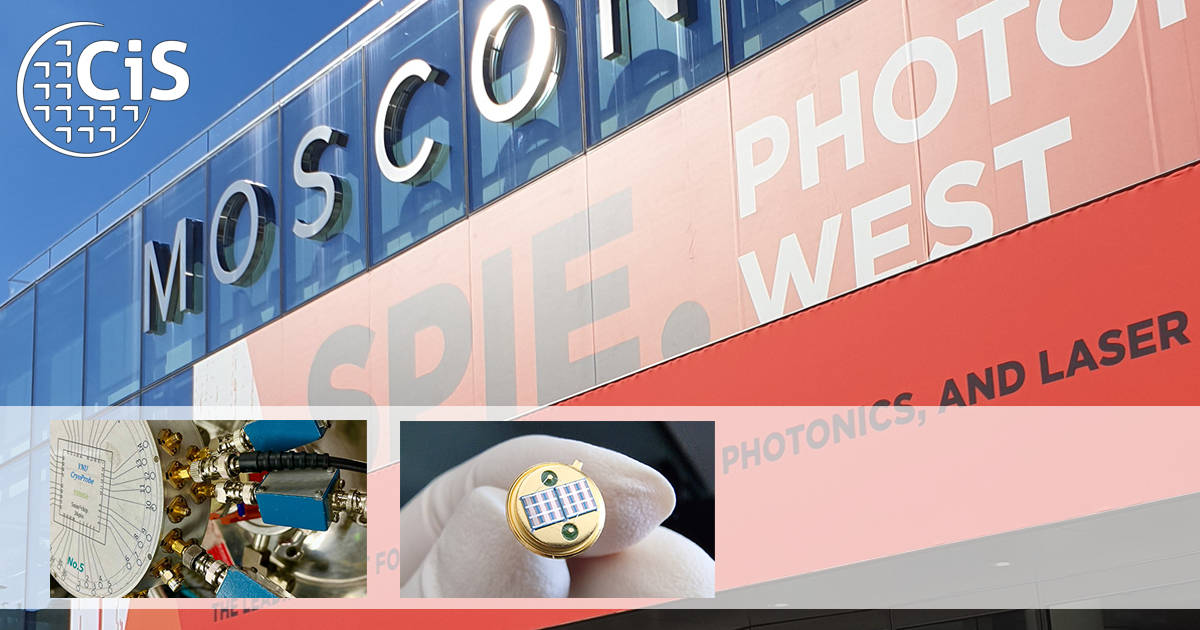
This weekend, SPIE Photonics West, the world’s leading event for lasers, biomedical optics, optoelectronics, biophotonics, quantum technology, and image processing, kicks off in San Francisco. The CiS Research Institute will be represented with two contributions in the extensive conference program.
In his presentation “Integrated digital system solution for superconducting quantum computing based on mK-generated single flux quantum pulse patterns for multi-qubit control” (Paper 13919-74), Prof. Thomas Ortlepp, Managing Director at the CiS Research Institute, explains research tasks in the development of scalable technologies for the production of a quantum computer. Among the various platforms, superconducting implementations represent a very promising approach. Currently, researchers are focusing, among other things, on scaling up to a large number of qubits, a prerequisite for practical application. So far, superconducting single flux quantum circuits (RSFQ and AQFP) have shown the lowest power loss currently technically possible. In addition, the operation of AQFP circuits at very low temperatures below 100 mK has recently been demonstrated. A new concept involves a digital control circuit based on quantized microwave pulse patterns. The presentation will discuss novel electronic circuits, the integration of qubits, and a compact and scalable approach to multi-qubit control using digital pulse patterns.
The presentation will take place on Wednesday, January 21, 2026, from 2:30 p.m. to 2:50 p.m. in Room 154, Moscone South, Upper Mezzanine.
 The research results are part of the funding measure: Quantum computer demonstration setups in the joint project “QSolid – Quantum computer in the solid state,” funded by the Federal Ministry of Research, Technology, and Space, funding code: 13N16172 for the QSolid consortium (BMFTR)
The second presentation on the topic of “Fast and efficient MEMS-IR emitters for advanced NDIR gas sensing” (Paper 13913-45) as part of the SPIE OPTO sub-conference will also take place on Wednesday, January 21, 2026, from 4:00 p.m. to 4:15 p.m. local time, in Room 156, Moscone South, Upper Mezzanine. The CiS Research Institute develops advanced MEMS-based infrared (IR) emitters for high-speed NDIR gas sensing. Standard MEMS IR sources are typically limited to a modulation of around 20 Hz. A new design covers the wavelength range from 2 to 20 µm and achieves modulation frequencies of up to 100 Hz. Using a multiphysics model in COMSOL, flanked by a neural network, material parameters can be determined very accurately and emitters optimized. The new single-membrane chips and chip arrays achieve up to 65% higher emission intensity at 60 Hz. These developments provide the basis for the development of compact and robust IR sources for a new, efficient generation of NDIR sensors.
 The presentation is based on the research and development work of the project “FIRE – Fast Infrared Emitter Array,” funding code: 49MF220020, and “KHIS Cost-Efficient Housing for IR Emitters,” funding code: 49MF220218, which were funded by the German Federal Ministry for Economic Affairs and Energy (BMWE).