
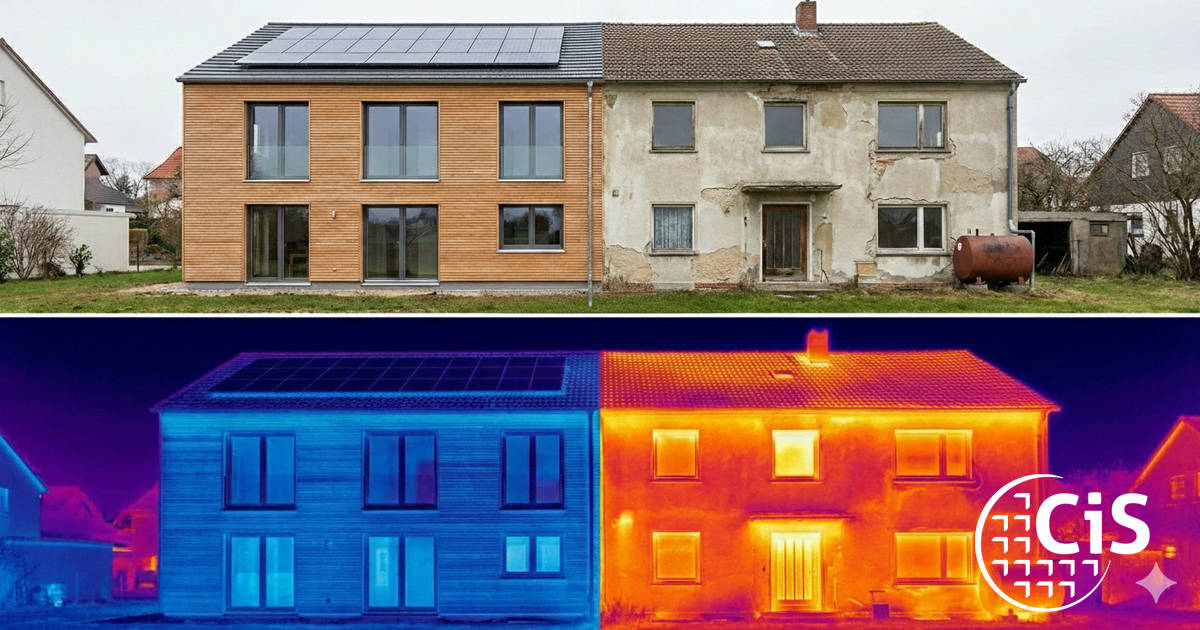
Thermografie: Der Wärmeverlust bei der linken Haushälfte (mit Dämmung) beträgt nur einen Bruchteil des Verlusts auf der rechten Seite (gelbe und rote Flächen verraten den Wärmedurchgang)
Almost all heat flow sensors available on the market operate according to the Seebeck effect. The CiS Research Institute has developed a temperature sensor that uses a different technology. This sensor has temperature diodes connected in series as its functional unit, which are also operated via a bridge circuit. Compared to the variants available on the market to date, the new development has several advantages: firstly, the sensor has a larger signal swing. Secondly, it can also measure absolute temperatures. Thirdly, it is considerably cheaper.
In addition, it offers the possibility of self-diagnosis, e.g. by operating the diodes in reverse direction to check whether they are still behaving as expected. The original version, which was based on a wafer stack, was supplemented by a layout with two opposing circuit boards and a quartz glass layer in between. This resulted in the development of a fast and inexpensive manufacturing process. The function of the chips was verified by independent measurements carried out by the Fraunhofer Institute in Freiburg (IPM).
The innovative heat flow sensor forms a solid basis for the development of customer-specific solutions and applications in the field of the constantly growing industrial surface temperature and heat flow technology.
 The research and development work described was funded by the German Federal Ministry for Economic Affairs and Energy (BMWE) as part of the “Si -Heat Flux Sensor” (Si-HFS) research project.
Funding code: 49MF220105