
The ever-increasing demand for computing power in recent years has led to tremendous advancements in the field of quantum computing, which could enable new applications in the natural sciences, engineering, medicine, and finance. Currently, a variety of approaches are being pursued to realize quantum computers, for example based on superconductivity, ion traps, photonic structures, quantum dots, or the targeted exploitation of defect complexes/color centers in semiconductor materials.
Silicon has the potential to accelerate ongoing research and development of quantum computers. The high quality of the starting material already enables very low-noise qubits. In addition, there is extensive expertise with dopants and material defects in semiconductor manufacturing. Silicon possesses many technological advantages, such as high CMOS compatibility, which enables high scalability. Other advantageous properties include long coherence times (the lifetime of a qubit) and fault tolerance. These are important criteria for the realization of quantum-based information processing.
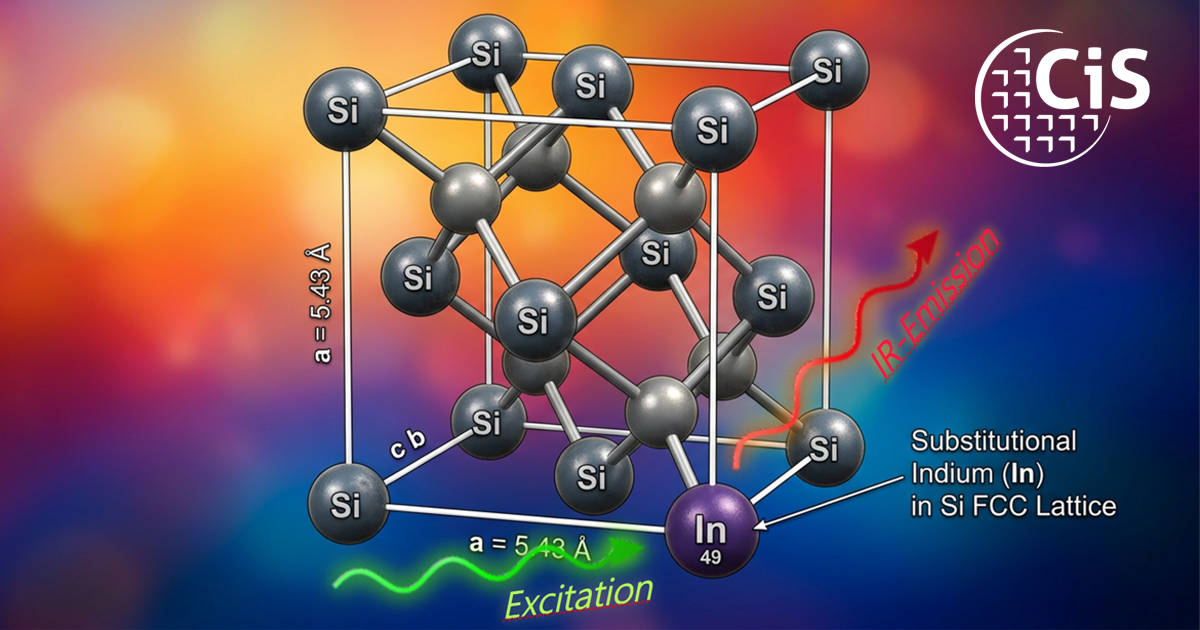
Color centers such as the G- or T-center in silicon are currently used as building blocks for silicon-based quantum computers and sensors; however, they are difficult to fabricate due to their complex structure. This project therefore aims to realize indium-based acceptor defects as readily accessible quantum systems for the first time. Indium has the unique property of forming a color center based on a singly charged pair complex at cryogenic temperatures, resulting in one of the strongest known infrared emitters. However, the bound partner is currently unknown, and its identification is therefore a prerequisite for scalable use as a qubit. The indium-based quantum systems are to be fabricated using microsystem technology and, when embedded in optimized photodetectors, will be both electrically controllable and readable. The insights gained into the structure and functioning of this elementary quantum building block in this research project can serve as a foundation for its continued integration into modern quantum computers and sensors.
 The research and development work described was funded by the Federal Ministry for Economic Affairs and Energy (BMWE) as part of the research project “Control of Acceptor-Based Quantum Structures in Si” (aQuSiS).
Funding code: 49VF250052