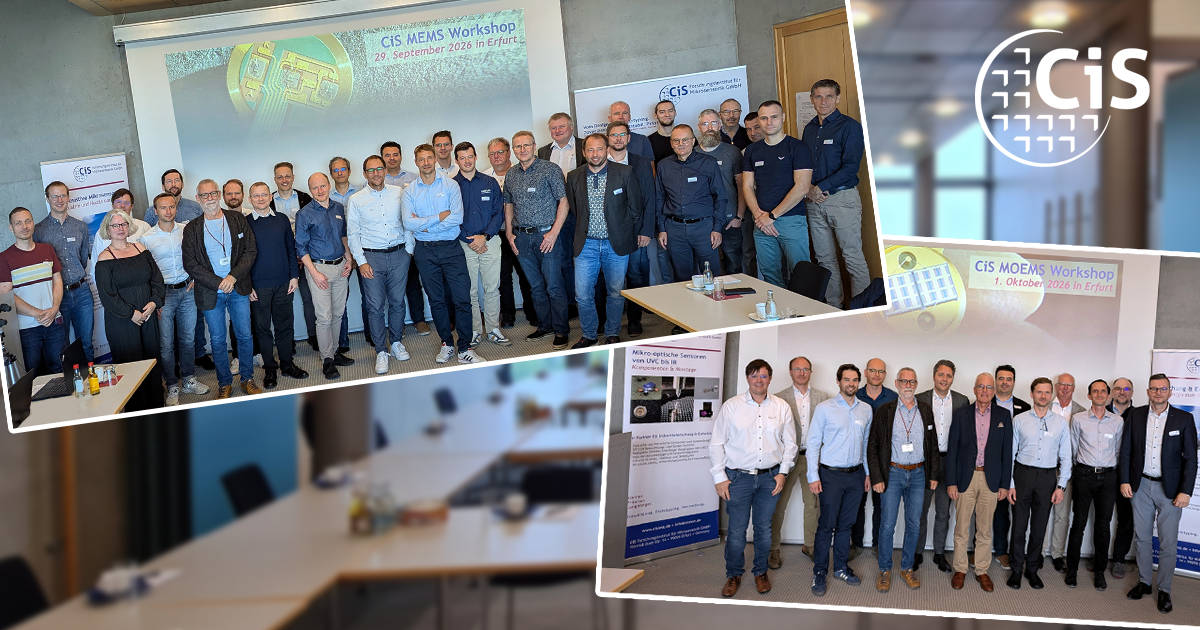
From virtual prototyping to innovative sensor technologies and high-tech applications in space, participants at the CiS-MEMS workshop held on 29th September 2026, in Erfurt discussed a wide range of topics. After a brief welcome by Dr. Olaf Brodersen (CiS e.V.), Dr. Timo Kober (Endress+Hauser) opened the program with his keynote address on “MEMS Pressure Sensors for Process Measurement Technology,” setting the stage for exciting discussions.
The subsequent sessions focused on technical issues and developments. Here, Dr. Bernhard Schwartz (CiS Research Institute) demonstrated the possibilities for developing silicon pressure sensors using coupled multiphysics simulations. Prof. Dr. Thomas Sattel (Ilmenau University of Technology) explained dynamic and sensitivity considerations in MEMS sensors and provided an introduction to the fundamentals of atomic force microscopy. This laid the groundwork for the presentation by Dr. Bernd Hähnlein (CiS Research Institute), who reported on the development of diamond tips for MEMS applications at the CiS Research Institute. Dr. Indira Käpplinger (CiS Research Institute) delivered another technical presentation on process stability in HF vapor etching for highly sensitive MEMS components.
The duo of Prof. Robert Täschner and Philipp Frenzel (West Saxon University of Applied Sciences Zwickau) presented chip-based MEMS/MOEMS sensors with palladium thin films for the electro-optical detection of hydrogen – even in oxygen-free atmospheres. These can be implemented cost-effectively using scalable wafer fabrication and, through additional material combinations and microstructuring, open up several research approaches for application-oriented improvements to the measurement range and response behavior.
Subsequently, Suhas Halthi Dakshira Muthi (Schmalkalden University of Applied Sciences) and winner of the 2025 Silicon Science Award explained the analysis of multimodal environmental stress factors in MEMS inertial sensor systems.
Specific applications were presented in the second session.
Reinhard Jurisch (microsensys GmbH) used numerous application examples to demonstrate how wireless RFID elements become autonomous data generators. Andreas Grundmann (ICM Chemnitz) provided a visual overview of sensor-based condition and position monitoring of forming tools in the context of internal high-pressure monitoring. In a journey into space, Tobias Schopf (Micro-Epsilon Messtechnik GmbH) explained the requirements and use of fast steering mirrors for laser-based satellite communication. Volker Hänsel (AVT Systems GmbH) concluded the series of presentations. His talk covered methods for examining fragile wafers using integrated on-wafer solutions for robust MEMS characterization.
With closing remarks by Dr. Olaf Brodersen (CiS e.V.), an intensive and successful workshop came to a close. Inspired by the presentations, discussions continued during the breaks – which felt far too short – and new opportunities for collaboration were identified. The networking between academia and industry took on particular significance once again at this workshop.
The workshop series continued on 1st October 2026. This event marked the fifth edition of the “CiS-NDIR Workshop: From Component to System” and once again showcased the latest developments in the world of optoelectronic sensors. Experts from research and industry discussed current developments, innovative sensor concepts, and future applications of NDIR and infrared sensor technology. The intensive technical exchange highlighted the technology’s great potential and provided valuable impetus for future collaborations and joint development projects.
Many thanks to all the speakers and participating guests at both CiS workshops for the lively exchange and exciting discussions.