
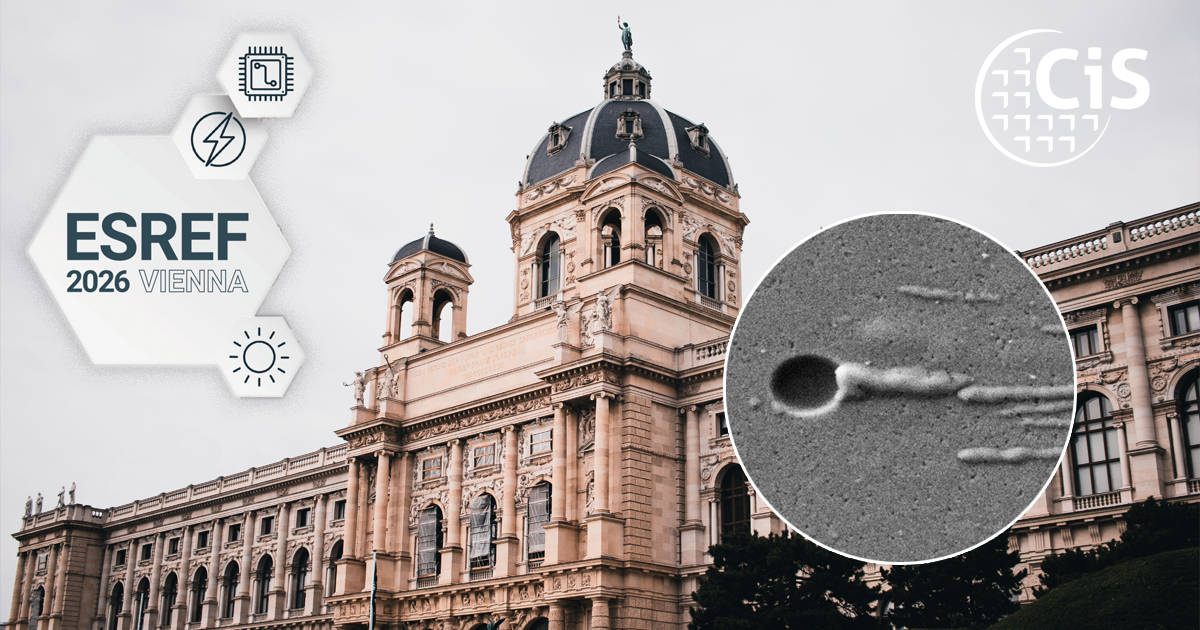
The ESREF (European Symposium on Reliability of Electron Devices, Failure Physics and Analysis) international conference focuses on the reliability and failure analysis of components in microelectronics, nanoelectronics, and optoelectronics. From 21st to 24th September 2026, experts from academia and industry will gather in Vienna to discuss everything from novel materials, failure mechanisms, and quality assessment to reliability testing and applications under demanding conditions.
On 24th September 2026, Julia Baldauf, a researcher at the CiS Research Institute, will present her findings on changes in MoSi₂ electromigration test structures in a presentation titled “Changes in lines under test containing artificially generated voids in molybdenum-implanted molybdenum disilicide due to electromigration” during Session B3 — Reliability for Nanoelectronics (Memory and Interconnect Technologies): Using a focused ion beam, artificial voids (holes) were introduced into electromigration test structures made of molybdenum-doped MoSi₂ to investigate the influence of deviations from perfect MoSi₂ stoichiometry on electromigration. The samples were then subjected to various current densities, and the changes in the test structures caused by the current were analyzed.
ESREF 2026 in Vienna was officially recognized as a “Green Event” in accordance with the City of Vienna’s “EcoEvent” guidelines, demonstrating that cutting-edge research and sustainability can go hand in hand.
 The research and development work described here was funded by the Federal Ministry for Economic Affairs and Energy (BMWE) as part of the research project “Doping of MoSi₂ resistive heating layers to improve service life by reducing electromigration in infrared emitters” (DotIR).
Funding code: 49MF240024