
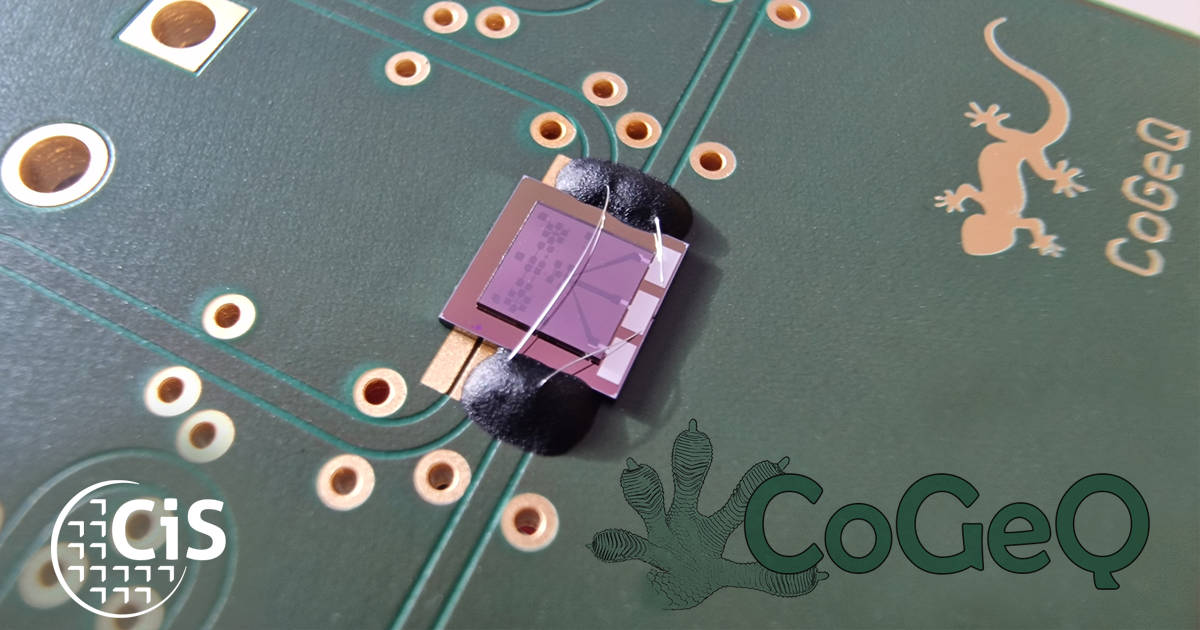
The final results of the research conducted as part of the “CoGeQ” project were presented at Quantum Photonics 2026 in Erfurt in early May. The “CoGeQ” collaborative project set out to demonstrate a mobile spin-based quantum processor based on NV centers in diamond.
These NV centers form the so-called qubits, which obey quantum theory and can be used at room temperature. Most previous research focused on proof-of-concept feasibility—in this project, the focus was on the scalability of the fundamental results of individual process steps along the entire value chain. The CiS Research Institute was responsible for the assembly and interconnection technology, which also included the fabrication of the silicon interposers. These carrier chips enable the complex and extremely dense interconnection of multiple chips (including those made of other materials), thereby allowing for a very compact design.
The project developed an efficient assembly process for the layered stacks consisting of a diamond chip and an interposer. This was based on a flip-chip assembly using gold stud bumps and a titanium-gold metallization, which enabled high-precision alignment of the chip stack with tolerances of less than 5 µm. The fabricated demonstrators were examined using ODMR (optically detected magnetic resonance) measurements, a highly sensitive spectroscopic measurement method. These silicon interposers can also be further functionalized. For example, tiny micromagnets were fabricated using the PowderMEMS® process, which generate the background magnetic field required for the operation of a spin-based quantum processor (publication: DOI 10.1016/j.mne.2025.100316).
In addition, the silicon interposers can also be equipped with advanced sensor functionalities. These include both temperature sensors and magnetic field sensors for determining the strength and direction of a BIAS magnetic field or a parasitic magnetic field. As an alternative to the design using a silicon interposer and a PCB, ceramic LTCC (low-temperature-cofired ceramics) circuit boards were also investigated, in which an additional interposer can be eliminated: In this case, the diamond chip is bonded directly to the LTCC circuit board.
The collaborative project was carried out in cooperation with the Universities of Leipzig, Kassel, and Ulm, as well as SaxonQ GmbH in Leipzig. As an associated partner in the European QuantERA project MAESTRO, the CiS Research Institute contributed its expertise to support the development of additional novel demonstrators.
These project results demonstrated key technological and industrial cornerstones for the production of spin-based quantum computers with high computing power.
 The project on which this article is based was funded by the Federal Ministry of Education, Research, and Space under grant number 13N16098.